How Obesity Affects Your Whole Health: Beyond the Scale
Weight is the number most people track, and it tells you the least about what obesity is doing inside your body. Blood pressure, blood sugar, joints, sleep, and mood all change long before the scale looks alarming. Several of them get better before that number drops much at all.
The scale misses a lot. That gap is why researchers spent the last ten years rethinking how obesity gets defined and treated.
Is Obesity a Disease? What Doctors Now Say
In January 2025, a group of global experts writing in The Lancet Diabetes & Endocrinology said obesity should be split into two diagnoses.
Clinical obesity means extra body fat is already keeping organs from working right. That makes it a disease on its own. Preclinical obesity means the extra fat raises your risk down the road, but nothing has broken yet.
Why split it? Because BMI can be misleading in both directions. It’s a useful starting point, and it’s still how clinical trials decide who qualifies for a study. But two people with the same BMI can be in very different health. The same report suggests pairing BMI with waist size, body fat, and signs of how the organs are actually working.
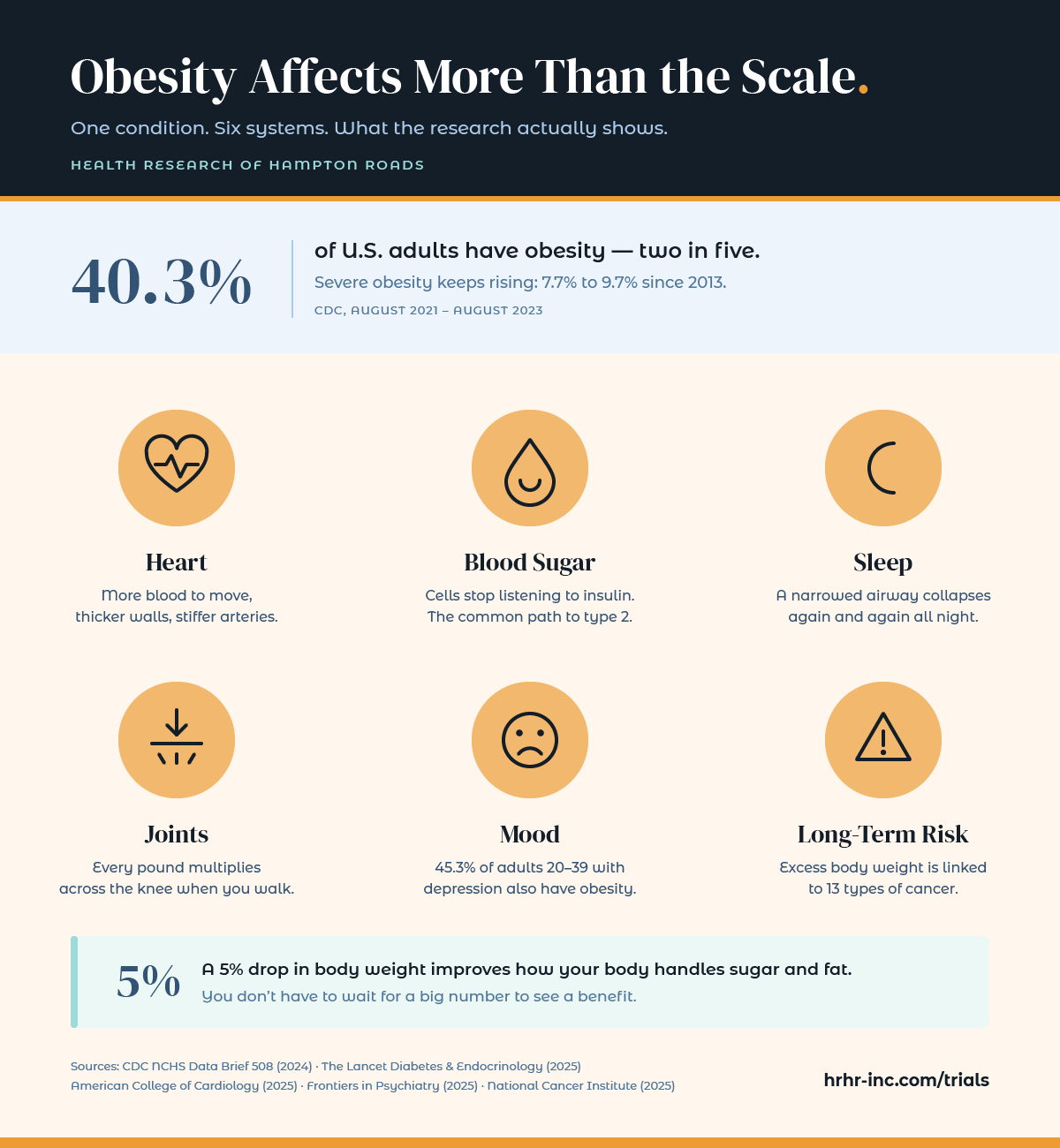
Two in five American adults, 40.3%, have obesity, according to CDC data collected between August 2021 and August 2023. Severe obesity affects 9.4%. For adults aged 40 to 59, the rate climbs to 46.4%. Overall obesity has held steady since 2013, but severe obesity keeps rising, from 7.7% up to 9.7%.
Obesity and Heart Disease: What Happens First
Extra body fat gives the heart more work to do long before you’d notice anything. There’s more blood to move, so the heart’s main pumping chamber gets thicker. Artery walls get stiffer. Fat around the belly and around the heart raises risk more than fat anywhere else.
The American College of Cardiology published a statement in June 2025 on treating obesity in adults with heart failure. Among heart failure patients in the hospital, obesity shows up in 32.8% of one common type and 23.2% of the other. The authors point to the fat sitting right against the heart. It helps cause the problem rather than just resulting from it.
Blood pressure and cholesterol move the same way. More body weight raises LDL cholesterol and triglycerides, another blood fat, while lowering the HDL that protects you. It also pushes up the top number in your blood pressure reading. Our post on LDL cholesterol explains how LDL turns into artery plaque, and our cholesterol and hypertension research page covers what HRHR studies there.
Obesity and Type 2 Diabetes: How Blood Sugar Changes
Body fat isn’t just storage. It sends out hormones and swelling signals. Those signals make your cells stop listening to insulin, the hormone that moves sugar out of your blood. Your pancreas makes more insulin to keep up. Eventually it can’t. That’s the most common path to type 2 diabetes.
That same low-level swelling also strains the liver and kidneys and damages arteries. One process, several diagnoses, treated by different doctors.
Losing weight interrupts it sooner than most people expect. Dropping 5% of your body weight improves how your body handles sugar and fat, per HRHR’s weight loss research page. That’s a much smaller target than the before and after photos suggest.
Obesity and Sleep Apnea, Joint Pain, and Daily Life
Sleep apnea tracks closely with body weight. Fat around the neck and upper airway narrows the passage, and it collapses over and over through the night. Broken sleep then raises blood pressure, worsens blood sugar, and makes you hungrier the next day. The problem feeds itself.
Joints work the same way, just mechanically. Every pound you carry multiplies across the knee when you walk, and knee arthritis rates climb sharply as BMI goes up. Pain limits activity, less activity adds weight, and the loop tightens. HRHR has a study opening soon that pairs knee arthritis with weight loss.
Then there’s what never shows up on a chart. Stairs. Airplane seats. Sleeping through the night. Keeping up with your grandkids. Quality of life is something trials actually measure now.
Obesity and Mental Health: The Link Runs Both Ways
Among US adults aged 20 to 39 with depression, 45.3% also have obesity. Among adults that age without depression, it’s 30.0%. Those numbers come from a 2025 review in Frontiers in Psychiatry.
It runs both directions. Obesity raises the odds of depression later through swelling and stress hormones. Depression raises the odds of weight gain later through appetite changes, medication side effects, and moving less. Weight stigma at the doctor’s office makes both worse. It keeps people from going at all.
Obesity and Cancer Risk: The Part Nobody Talks About
The National Cancer Institute links extra body weight to 13 cancers. The list includes cancers of the uterus, esophagus, liver, kidney, pancreas, and colon, plus breast cancer after menopause. Using 2019 numbers, extra body weight accounted for 10.6% of new cancers in US women aged 30 and up, and 4.8% in men. For uterine cancer alone, it’s 53.1%.
Most people can name the diabetes and heart disease link. Almost nobody names this one.
Obesity Clinical Trials: What Researchers Are Testing Now
Obesity treatment used to be a lifestyle conversation. Now it’s largely a medication one. GLP-1 drugs changed what medicine can do here, and the newest step is a version you swallow instead of inject. We covered the FDA approval of orforglipron, the first oral GLP-1 pill for long-term weight management. HRHR helped run the research behind it.
What’s changing now is what gets measured. Obesity clinical trials used to count pounds lost. Newer studies ask different questions. Does the treatment prevent heart attacks? Clear up sleep apnea? Ease knee pain? Help the liver? Lower blood pressure? That follows from the new definition. If obesity is a disease that keeps organs from working, the test of a treatment is whether the organs recover.
It’s also why weight loss clinical trials at a site like HRHR involve more than a scale. Participants get lab work, heart monitoring, and regular time with clinical staff over months of visits.
How to Join a Weight Loss Clinical Trial Near You in Hampton Roads
HRHR has been an FDA-regulated research site in Newport News since 1998. Since 2017, the site has helped bring 10 treatments to market, including work on semaglutide and orforglipron. Searching for weight loss trials near me? If you live in Newport News, Norfolk, Virginia Beach, or Hampton, this is the site you’re looking for.
Two studies are open or opening soon. One is a weight loss study for people without diabetes. The other pairs knee arthritis with weight loss. You get paid for each visit you complete, and you don’t need insurance.
See what’s open on our currently enrolling trials page, read more about our weight loss research, or apply to a paid research study directly. Call (757) 591-8100 if you’d rather talk to someone first.
Frequently Asked Questions
Is obesity a disease or a lifestyle choice?
Doctors classify obesity as a chronic disease. The 2025 Lancet Commission went further and split it in two. Clinical obesity is when extra fat is already keeping organs from working right. Preclinical obesity means the risk is higher but nothing has broken yet. Genes, hormones, medications, and sleep all play a role alongside diet and exercise.
How much weight do you have to lose before your health improves?
Less than most people think. A 5% drop in body weight improves how your body handles sugar and fat, per HRHR’s weight loss research page. Blood pressure, blood sugar, and sleep often improve in that same range. Waiting for a big number is a good way to quit before the benefits show up.
Can obesity cause high blood pressure?
Yes. Extra body fat means more blood to pump, turns on hormone systems that hold onto salt, and stiffens artery walls. High blood pressure shows up alongside obesity often, and it usually improves as weight comes down.
What actually happens in an obesity clinical trial?
You start with a screening visit that goes over your medical history and checks if you qualify. Then you sign an informed consent form. After that, most visits include a physical exam, lab work, vital signs, and either the study drug or a placebo. HRHR’s weight loss studies run anywhere from several months to two years.
Do participants get paid for weight loss clinical trials?
HRHR pays participants for each completed office visit. The amount depends on the study. Our guide to paid clinical trials in Hampton Roads explains how it works.
Do I need to have diabetes to join a weight loss study?
No. HRHR runs weight loss studies just for adults without diabetes, plus separate studies for people managing other conditions. Every study has its own rules, and the screening visit walks you through them.

Scheduling Soon: Weight Loss for Non-Diabetics
Males and Females, 18-75 years of age
This clinical trial will focus on a weight loss treatment for obese males and females. This trial will allow for only non-diabetics.
Eligibility
- Cannot have type I or type II diabetes.
- Cannot have had a previous weight loss surgery.
- Cannot have used GLP-1 medications in the last 6 months.
Trial Duration
15 months with 16 office visits.
Compensation
Varies per completed office visit.
Apply to this trial
Scheduling Soon: Knee Osteoarthritis + Weight Loss
Males and females, 18+ years of age
This trial is for obese non-diabetic adults with knee osteoarthritis, and who are highly motivated to lose weight.
Eligibility
- Must NOT have diabetes
- Must NOT have had a previous weight loss surgery
- MUST be available for morning office visits only. No afternoon office visits are available
- No weight loss medication use in the last 12 months
- MUST be willing to have a knee X-ray performed
Trial Duration
18 appointments over almost 2 years.
Compensation
Varies per completed office visit.
Apply to this trialLatest Insights
How Obesity Affects Your Whole Health: Beyond the Scale
Understanding the mRNA Flu Vaccine: What You Need to Know